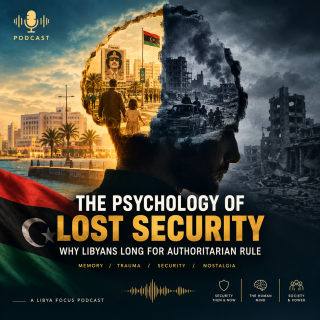
Ep. 19
What happens to the collective human mind when a sudden transition to “freedom” strips away basic survival, physical safety, and public order?
In this episode, we unpack the profound psychological link between lost security and authoritarian nostalgia, using the post-2011 collapse of Libya as a stark, cautionary case study. When a highly centralized state is abruptly dismantled, the vacuum is often filled by decentralized militia violence, economic decay, and constant instability. Rather than embracing democratic ideals, a traumatized society often undergoes a psychological retreat, reframing the predictable repression of the past as a desirable sanctuary.
We explore this complex psychological coping mechanism through four core dimensions:
Abstract Liberty vs. Existential Survival: Why absolute freedom, when stripped of institutional order, transforms into an anxiety-inducing burden that drives individuals to prefer the predictable injustice of autocracy over the erratic chaos of lawlessness.
The “Political Orphanhood” of Paternalistic Societies: How dictatorships systematically infantilize society by positioning the leader as the all-providing, absolute “Father”. When this parental figure is violently removed, the collective consciousness experiences a devastating sense of “political orphanhood” (يُتم سياسي).
Cognitive Filtering and the Selective Memory Shield: The way the mind selectively edits historical memory - sanitizing omnipresent state surveillance and human rights abuses - to focus exclusively on the lost benefits of state-provided healthcare, education, and subsidized stability.
Outcome-Oriented Pragmatism: A deep dive into empirical public opinion from the Arab Barometer, explaining why 75% of Libyans agree that government type does not matter as long as it maintains public order, and 71% desire a strong leader who can “bend the rules” to resolve national crises.
Join us for a rigorous look at how systemic trauma shifts societal values, forcing a desperate preference for stable autocratic outcomes over fragile democratic processes