Ep. 17
What if the international community stops trying to solve Libya?
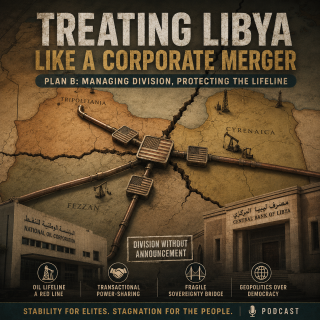
This episode explores a provocative “Plan B” for Libya: a scenario in which efforts to achieve political and institutional unification fail, and the United States and its European partners shift toward managing the country’s division rather than overcoming it.
The logic is strikingly transactional. Libya’s rival political and military networks could be treated less like competing visions of a state and more like shareholders in a difficult corporate merger—with a power-sharing bargain between dominant networks in the West and East taking precedence over another attempt at forced political reunification.
At the center of this strategy is oil. Libya’s energy sector becomes a red line that cannot be allowed to collapse with the political system. The National Oil Corporation and Central Bank of Libya would remain essential pillars of a unified economic lifeline, protecting energy production, international investments, and the financial mechanisms that keep the rentier state functioning.
The result would not necessarily be an officially partitioned Libya. There would be no new borders, flags, or formal recognition of two states. Instead, Libya could remain internationally recognized as one country while functioning, in practice, as two increasingly autonomous systems.
This “division without announcement” would preserve just enough common infrastructure—currency, central financial institutions, oil revenues, international representation, and budget arrangements—to keep the broader system alive.
But there is a profound cost.
For international powers, a fragmented yet predictable Libya may be preferable to a renewed civil war. For Libya’s citizens, however, managed fragmentation could mean continued institutional decay, inflation, weak governance, and political paralysis.
The central question of this episode is therefore uncomfortable but fundamental:
If Libya cannot be unified, will the international community eventually decide that managing its division is good enough?